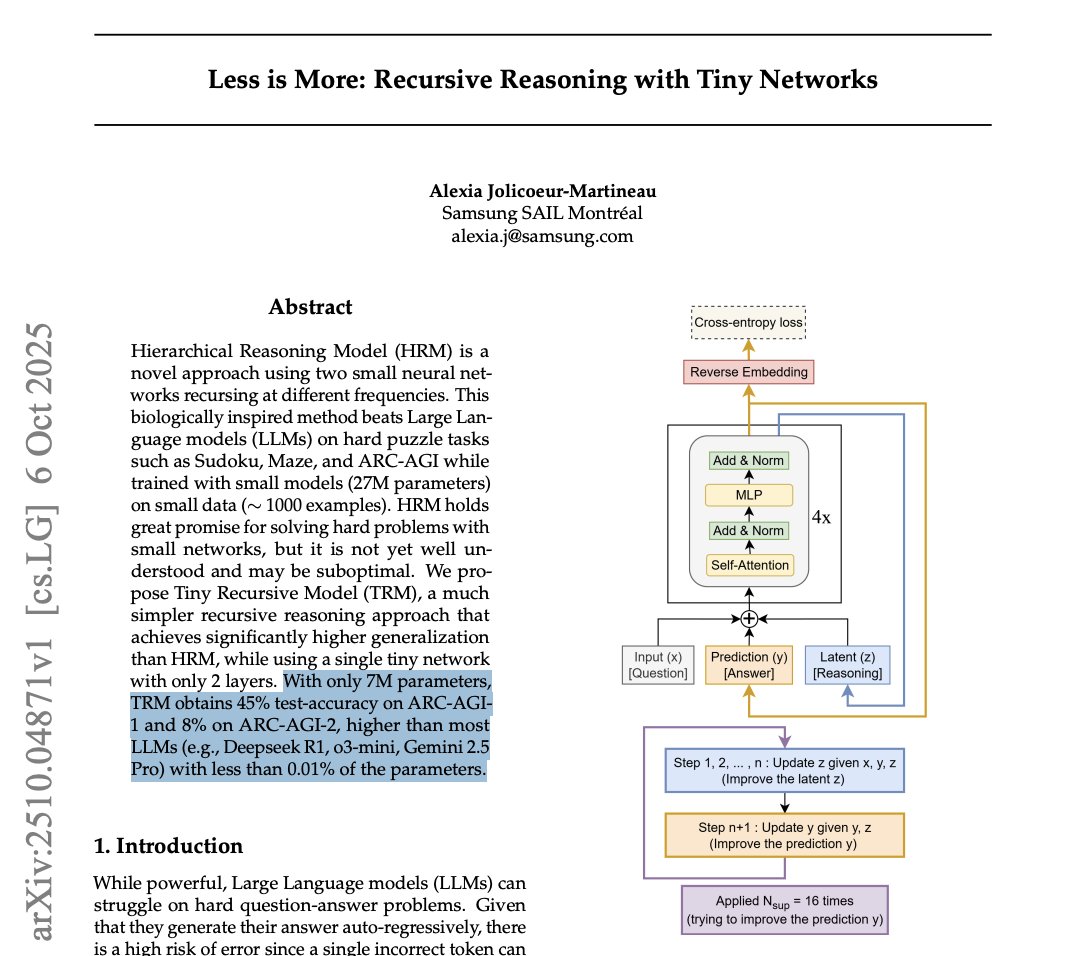
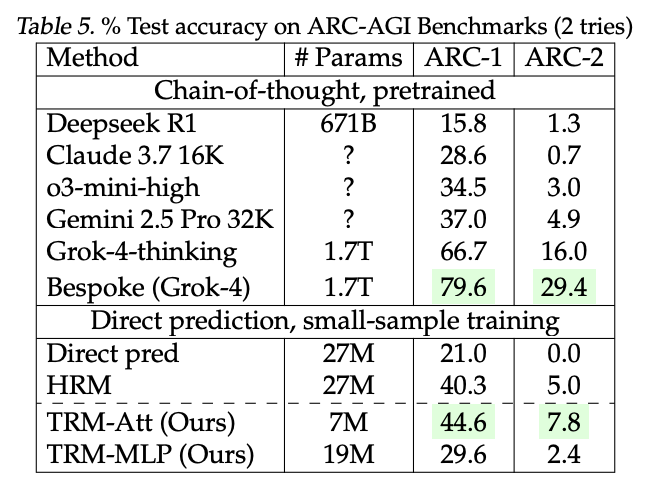
Samsung Recursive Model tiny Million parameter model just beat DeepSeek R1 Gemini pro and o3 mini at reasoning on both ARG AGI ARC It called Tiny TRM from How can 10 000x smaller be smarter Here how it works Draft an Initial Answer Unlike LLM that writes word by first generates quick complete draft of the solution Think this as its rough guess Create Scratchpad then creates separate space for internal thoughts latent scratchpad This is where real magic happens Intensely Self Critique The enters intense inner loop compares answer to original problem refines over times in row asking itself Does my logic hold up Where are errors Revise After focused thinking uses improved create brand new much better final Repeat until Confident entire process think revise repeated 16 Each cycle pushes closer correct logically sound Why matters Business Leaders what algorithmic advantage looks like While competitors paying massive inference costs brute force scale more efficient deliver superior performance fraction cost Researchers major validation neuro symbolic ideas ability recursively before acting demonstrates architecture not primary driver Practitioners SOTA no longer gated behind billion dollar GPU clusters paper provides highly light blueprint building specialized reasoners run anywhere isn scaling down completely different deliberate way solving problems

A tiny 7 Million parameter model just beat DeepSeek-R1, Gemini 2.5 pro, and o3-mini at reasoning on both ARG-AGI 1 and ARC-AGI 2. It’s called Tiny Recursive Model (TRM) from Samsung. How can a model 10,000x smaller be smarter? Here’s how it works: 1. Draft an Initial Answer: Unlike an LLM that writes word-by-word, TRM first generates a quick, complete “draft” of the solution. Think of this as its first rough guess. 2. Create a “Scratchpad”: It then creates a separate space for its internal thoughts, a latent reasoning “scratchpad.” This is where the real magic happens. 3. Intensely Self-Critique: The model enters an intense inner loop. It compares its draft answer to the original problem and refines its reasoning on the scratchpad over and over (6 times in a row), asking itself, “Does my logic hold up? Where are the errors?” 4. Revise the Answer: After this focused “thinking,” it uses the improved logic from its scratchpad to create a brand new, much better draft of the final answer. 5. Repeat until Confident: The entire process, draft, think, revise, is repeated up to 16 times. Each cycle pushes the model closer to a correct, logically sound solution. Why this matters: Business Leaders: This is what algorithmic advantage looks like. While competitors are paying massive inference costs for brute-force scale, a smarter, more efficient model can deliver superior performance for a tiny fraction of the cost. Researchers: This is a major validation for neuro-symbolic ideas. The model’s ability to recursively “think” before “acting” demonstrates that architecture, not just scale, can be a primary driver of reasoning ability. Practitioners: SOTA reasoning is no longer gated behind billion-dollar GPU clusters. This paper provides a highly efficient, parameter-light blueprint for building specialized reasoners that can run anywhere. This isn’t just scaling down; it’s a completely different, more deliberate way of solving problems.
Published on 2025-10-08 , updated on 2025-12-07
12/3/2025 分享

AI Concern - Sam Altman

Sam Altman on Fox News just admitted what most tech CEOs won’t say out loud: AI is already diagnosing diseases doctors couldn’t Kids are getting free world class tutors Small businesses are punching way above their weight But the downside he finally acknowledged: Millions of jobs will vanish forever State level cyberweapons are now trivial to build If China or others leapfrog the US, it’s a national security disaster His words: “Some jobs will go away entirely… adversaries getting ahold of these would be a national security issue.” Rare, unfiltered honesty from the man steering it all.

12/2/2025 分享

AI concern

Google CEO Sundar Pichai just told Fox News the one AI nightmare that actually keeps him awake: “When deepfakes get so good that we literally won’t be able to tell what’s real anymore… and bad actors get their hands on it.” His exact words after Shannon Bream pressed him: “That’s the kind of thing you sit and think about.” He still believes humanity can steer it toward curing cancer — but the clock is ticking. This 64 second clip is chilling.